(Non-Surgical Heart Blockage Treatment Explained in Simple Words)
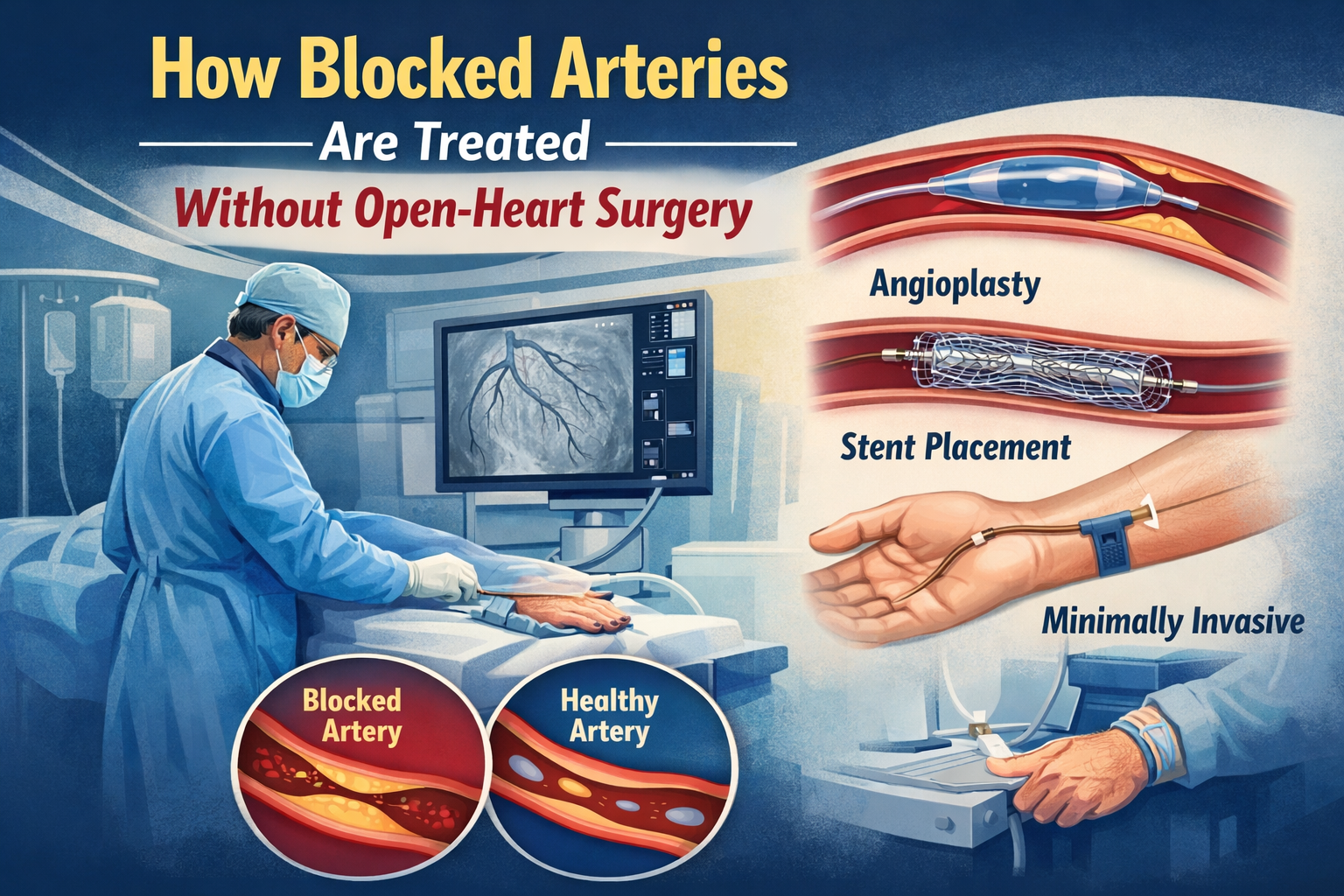
Blocked arteries (most commonly in the heart) are a major cause of chest pain, breathlessness, and heart attacks. The good news is: many patients can now be treated without open-heart surgery. Thanks to modern interventional cardiology, several procedures can open blocked arteries through a tiny puncture in the wrist or groin—often with faster recovery, less pain, and shorter hospital stay.
In this blog, you’ll understand how blocked arteries are treated without open-heart surgery, who is eligible, what procedures are used, and what recovery looks like.
Your arteries carry oxygen-rich blood to your heart and body. When fat deposits, cholesterol, and inflammatory cells build up inside the artery wall, they form plaque. Over time, this plaque can narrow the artery (stenosis) and reduce blood flow.
When the heart doesn’t get enough blood flow, it can lead to:
Yes—in many cases.
Open-heart surgery (like bypass surgery) is not always required. If the blockages are suitable, interventional cardiologists can treat them with minimally invasive procedures, such as:
These procedures are performed inside a Cath Lab, usually under local anaesthesia, without opening the chest.
Before treatment, doctors must identify:
Coronary angiography is a test where a thin tube (catheter) is inserted through:
A contrast dye is injected, and X-ray imaging shows the artery blockages clearly. This procedure is:
Angiography is the key step that helps the doctor decide the best treatment plan.
If the blockage is treatable without bypass surgery, the most common method is coronary angioplasty.
Angioplasty is a minimally invasive procedure where a tiny balloon is taken to the blocked area and inflated to widen the artery and restore blood flow.
How it works (simple explanation):
Angioplasty can:
Most angioplasties are combined with stent placement.
A stent is a tiny metal mesh tube that acts like a scaffold to keep the artery open after angioplasty.
A well-placed stent restores blood flow and helps patients return to daily life faster compared to open-heart surgery.
Not all blockages are simple. Some patients have long-standing or heavily calcified blockages. Even in such cases, many can still be treated without open-heart surgery using advanced techniques:
CTO stands for Chronic Total Occlusion, meaning the artery has been fully blocked for months or years. Earlier, such cases often required bypass surgery. Today, specialised interventional methods can sometimes open these blockages using advanced wires and techniques.
If plaque is hard like calcium, a balloon alone may not open it. Devices like:
Intravascular imaging tools can guide stent placement with better accuracy:
These tools help ensure:
Many patients can avoid bypass surgery when:
However, bypass surgery may still be recommended when:
A good heart specialist will always suggest the safest and most effective plan based on angiography findings.
Minimally invasive treatments like angioplasty and stenting offer several advantages:
Long-term success depends on both the procedure and consistent lifestyle + medication adherence.
Seek medical help immediately if you have:
Early diagnosis can prevent major heart damage and reduce the chance of needing open-heart surgery.
Since many blocked artery treatments rely on precision, experience, and decision-making, selecting the right specialist plays a major role in outcomes—especially in complex cases like CTO, calcified blocks, or high-risk angioplasty.
Dr. Gautam Naik is widely regarded as one of the best interventional cardiologists in India, known for advanced expertise in diagnosing and treating coronary artery blockages through minimally invasive, catheter-based procedures. Under the guidance of a highly experienced interventional cardiologist like Dr. Gautam Naik, patients can explore modern options that may help them avoid open-heart surgery whenever clinically appropriate.
Blockages are not “removed” like scraping; instead, arteries are opened using balloons, stents, and advanced plaque-modification techniques.
It depends on the number, location, and complexity of blockages. Some cases are best treated by stents; others may need bypass.
Yes, it’s a common and generally safe procedure when done in a well-equipped Cath Lab by an experienced interventional cardiologist.
Stents are designed to last long-term. The key is taking medicines and following lifestyle advice to avoid new blockages.
Yes, re-narrowing can happen in some cases, but modern drug-eluting stents and correct medication greatly reduce the risk.
Blocked arteries can be serious, but modern heart care has made treatment far less invasive than before. With procedures like angiography, angioplasty, and stenting, many patients can restore blood flow without open-heart surgery—often with faster recovery and excellent outcomes.
If you or your family member has symptoms of heart blockage, early evaluation by an experienced interventional cardiologist can make all the difference.