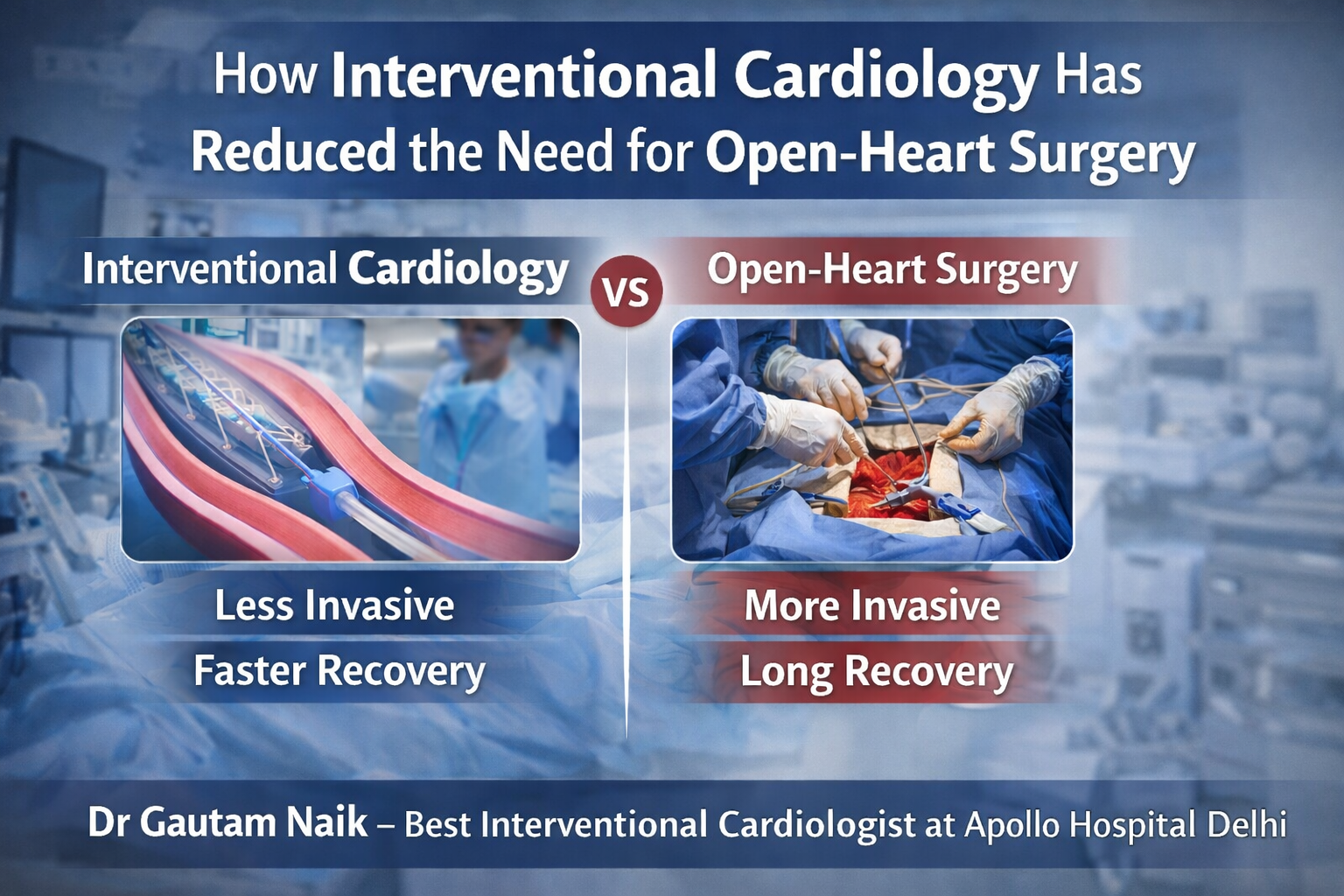
Over the last two decades, heart care has undergone a remarkable transformation. Procedures that once required large chest incisions, prolonged hospital stays, and months of recovery are now being treated through tiny punctures using highly advanced technology. This shift is largely due to the rapid progress of interventional cardiology, a specialised branch of cardiology that focuses on minimally invasive, catheter-based treatments.
Today, thousands of patients who would earlier have been advised open-heart surgery are instead recovering faster and safer with interventional procedures—especially with the best cardiologist in Apollo Hospital, Delhi, under expert specialists such as Dr Gautam Naik.
Open-heart surgery involves opening the chest and operating directly on the heart. It has been lifesaving for decades, especially for:
However, open-heart surgery also comes with:
As medical science evolved, cardiologists and researchers began exploring less invasive alternatives—leading to the rise of interventional cardiology.
Interventional cardiology treats heart conditions using catheters inserted through blood vessels, most commonly from the wrist or groin. These procedures do not require opening the chest or stopping the heart.
Common interventional cardiology procedures include:
This approach has dramatically changed how heart diseases are treated worldwide.
Earlier, patients with significant coronary artery disease were routinely advised bypass surgery. Today:
For many patients, angioplasty offers results comparable to surgery—without the trauma of open-heart procedures.
In the past, emergency heart attack care options were limited. Now:
Fast, expert intervention—especially by an experienced interventional cardiologist—often eliminates the need for emergency bypass surgery.
Certain heart valve conditions can now be treated using catheter-based techniques:
These methods are especially beneficial for:
One of the biggest advantages of interventional cardiology is patient comfort and safety:
This makes it a preferred option for both patients and doctors whenever clinically appropriate.
While interventional procedures are less invasive, they are highly skill-dependent. The success of these treatments relies on:
This is why choosing the right interventional cardiologist and hospital is crucial.
At Indraprastha Apollo Hospital, New Delhi, Dr Gautam Naik is widely recognised for his expertise in interventional and structural cardiology. With extensive experience in managing:
Dr Naik is regarded by many patients and peers as one of the best interventional cardiologists in Delhi. His approach focuses on:
Under his care, numerous patients who were once considered surgical candidates have successfully undergone catheter-based treatments instead.
Despite major advancements, open-heart surgery remains essential in certain situations, such as:
A responsible interventional cardiologist will always recommend surgery when it offers the safest and best long-term outcome for the patient.
Interventional cardiology continues to evolve with:
As technology progresses, the dependence on open-heart surgery is expected to reduce further—making heart treatment safer, quicker, and more patient-friendly.
Interventional cardiology has revolutionised cardiac care by offering effective, minimally invasive alternatives to open-heart surgery. From treating blocked arteries to managing heart attacks and valve diseases, these techniques have transformed outcomes and recovery for patients.
In centres like Indraprastha Apollo Hospital, Delhi, specialists such as Dr Gautam Naik are playing a key role in this transformation—helping patients receive world-class heart care with less pain, lower risk, and faster recovery.